Trust in journalism never really crossed my mind when I started in broadcast journalism after graduating from the University of Southern Mississippi in 1992. At that time, most people trusted reporters. However, that trust has eroded significantly since then even though many traditional journalists still follow the standards taught in college and reinforced in newsrooms. (Among them are The Associated Press, Reuters and the Society of Professional Journalists.)
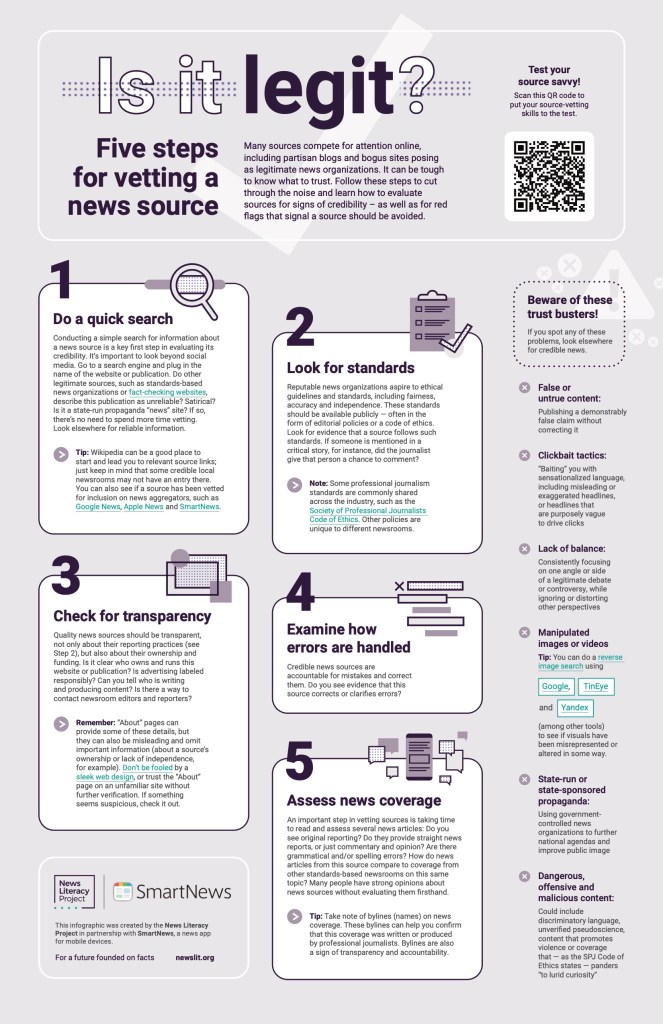
Because of that erosion, the group Trusting News started in 2016 to help journalists in general get that trust back. I subscribe to the organization’s weekly newsletter, and the latest one shared checklists that reporters could share to help people decide if something they see online is legitimate. Trusting News project manager Mollie Muchna wrote the following:
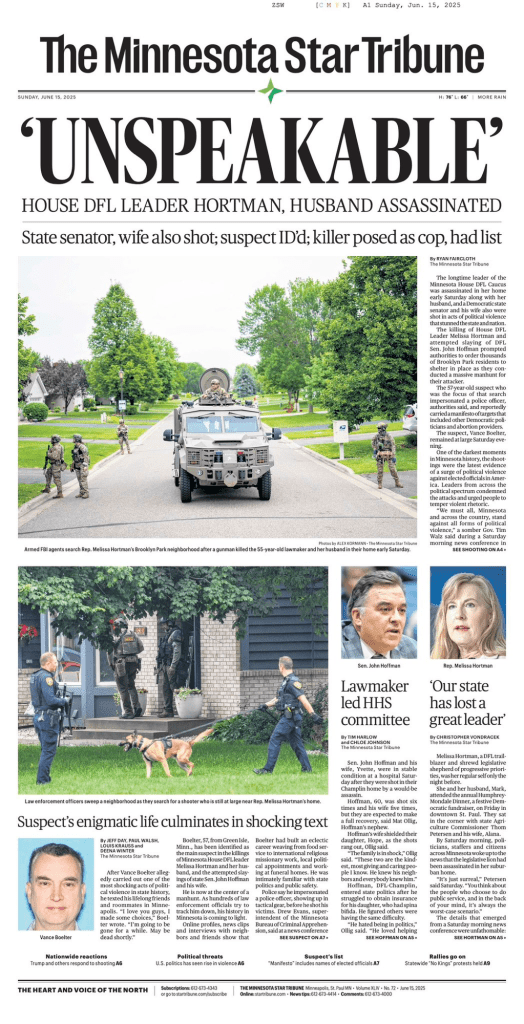
I have been retired from full-time journalism for about a year now. But when sharing news stories online, I still use those journalistic standards that guided me for more than three decades on the job. My hope is you notice that in the stories appearing on my social media accounts as well as on this website. I also hope you find the information that shows up when clicking on the images in this post helpful.
At this point in our country, great reporting isn’t a craft or a talent. It is a patriotic act. It presents the facts on which we can build a serviceable picture of what happened, of right and wrong. This steadies the civic mind.
What reporters do is hard—find human beings in the thicket, in the wild, earn their trust, convince them to speak, read opaque documents, decipher things, restrain their own views, get the facts accurately and then let those facts speak for themselves.
A little side trip here to Walter Cronkite, whose name is being mentioned a lot. “Everyone trusted Cronkite.” True. I knew him, he was human, and he wasn’t trusted because he had nice eyes or a nice way or a well-lit set or smoked a pipe.
People trusted him because for much of his career he’d been a workaday reporter at United Press International. And it formed him, shaped his journalism. UPI, the Associated Press and other wire services told America what was happening each day in the country and the world.
Here is what the wires taught you. Their product was purchased and had to be acceptable to every newspaper in the country—liberal and conservative, big city and small. So wire service reporters had to play it straight—get it first but get it right, facts are gettable, verification necessary. You disciplined yourself out of the story. Accuracy was all.
Because of that training, viewers could tell Cronkite was a professional operating under clear and continuing standards.
People think journalism is hopelessly tainted, just another partisan player, can never get its reputation back. Wrong. You can build it each day. You can open up a new account in the credibility bank, see it grow. When Cronkite said Vietnam was a failure, he was believed because he had a big personal account to draw on.
Peggy Noonan in The Wall Street Journal on January 31, 2026
An analysis by The Economist found strong links between media-muzzling and corruption. Looking at 80 years of data from about 180 countries collected by v-Dem, the news outlet found that a reduction in media freedom in a given country was a strong predictor that graft in that country would subsequently grow worse. This held true even after correcting for past and current levels of corruption, change in incomes and worldwide trends.
To be a foreign correspondent is to be a witness. To be a clear voice in a world that is often marred by violence and misinformation. Our work and responsibility should not be taken lightly.
But I stand before you tonight not to speak about my achievements, but rather to tell you about the humans I’ve met along the way. And about the brave journalists who are risking their lives to tell the realities around them.
So let me begin by acknowledging the fearless and tenacious Palestinian journalists in Gaza who do not have the luxuries we are afforded to simply leave when the story becomes too dangerous. May we not forget their sacrifice and contributions to our industry.
Let me also reiterate the position that international journalists must be given independent access to Gaza to report.
This work does not feel like a job to me, but rather a mission and a purpose to go to the places that others won’t go and tell the stories that otherwise wouldn’t be told.
To places like Israel, speaking with the hostages who were released from Hamas captivity after surviving a brutal terrorist attack or to Syria hearing from the mothers we met at the infamous Sednaya prison who continue to look for their children or to Ukraine interviewing President Zelenskyy on the eastern front lines, our work will continue to focus on the experience of humans amid conflict.
We must continue to speak loudly and fairly, even when it is unpopular to do so. We must hold governments and militaries accountable for their actions. And we must continue to be a voice for the voiceless.
Fox News chief foreign correspondent Trey Yingst upon receiving the Prize of Excellence at the annual Foreign Press Awards
Sometimes as a reporter, you have to go above and beyond to get the story. I can’t help but laugh at what ESPN’s Marty Smith shared about how he got to Lane Kiffin on the tarmac before leaving Oxford for Baton Rouge. You can watch it at the bottom of this post.
This is the loaf of bread. I took this photo Thanksgiving night at the Birmingham Airport before I set sail. Grateful we had her. She corners like a Ferrari. https://t.co/vDC2DLgzQppic.twitter.com/qUP2mpwkky
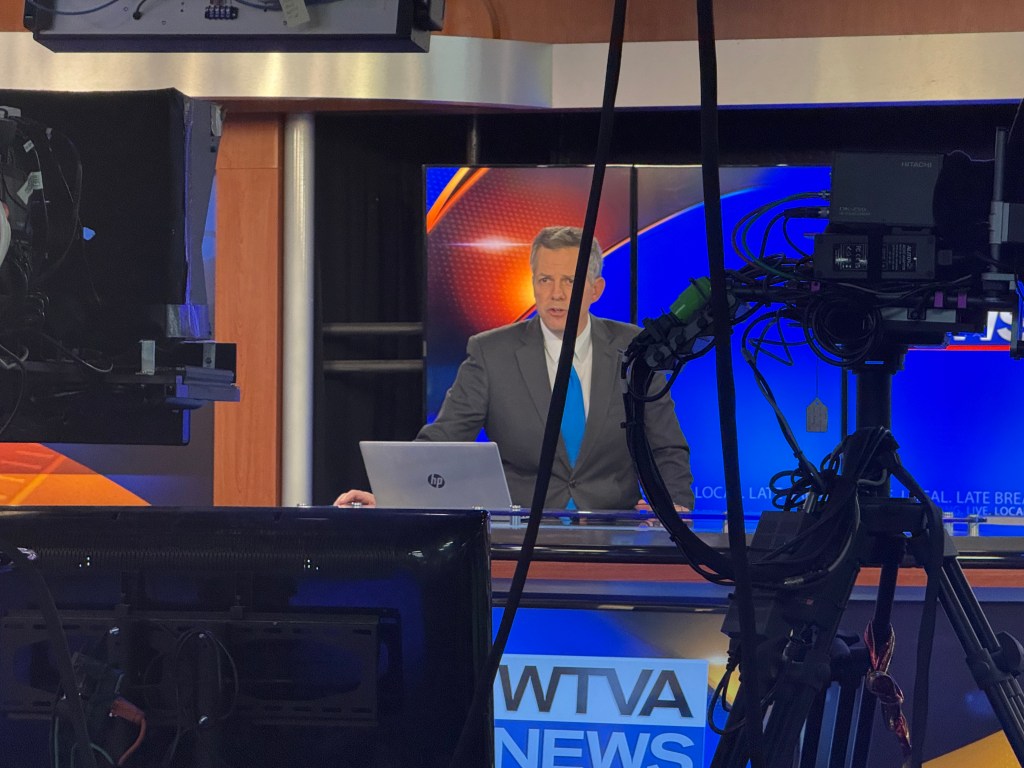
WTVA is being acquired by Gray Media in a $171 million deal where Allen Media Group is selling ten of its television stations to the broadcast giant.
The purchase of Northeast Mississippi’s top-rated television station enhances Gray’s portfolio of television stations in the state and across the South, many of which have a strong commitment to journalism. The acquisition gives the company a television station in every Mississippi TV media market except Greenwood-Greenville. Gray also owns TV stations in Birmingham, Memphis, Nashville and Huntsville. In addition, it recently created broadcast TV sports networks in the Nashville and New Orleans regions.
The purchase of WTVA, which still needs federal approval, will end the five years of ownership by comedian and entrepreneur Byron Allen. That five years included job cuts and plans by his company earlier this year to replace the station’s local weather department with coverage from The Weather Channel. The plan was scrapped after a week of harsh public criticism.
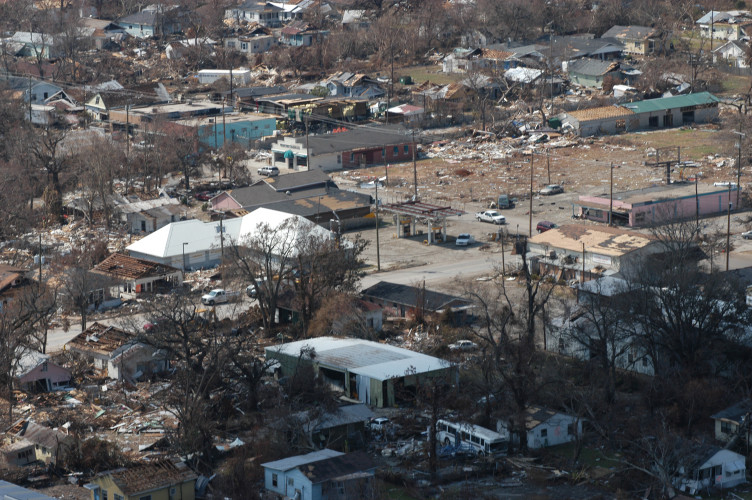
Aerial view of damage in Gulfport, Mississippi, from Hurricane Katrina taken September 6, 2005. Department of Homeland Security. Federal Emergency Management Agency. Office of External Affairs. Public Affairs Division.
Sportswriter Sally Jenkins referenced her reporting in Mississippi on Hurricane Katrina in the announcement to her colleagues she is leaving The Washington Post to become a staff writer for The Atlantic:
Only the people who live their work in a newsroom will understand this: one of the best tastes I ever had was in a Mississippi motel parking lot at 1 a.m. sharing shots of Maker’s Mark, neat, with Washington Post photographers out of a makeshift bar in the back of a rented SUV. We’d spent the day covering the damage Hurricane Katrina had wrought with a 22-foot wall of water and 160 mph winds, and our dinner was whiskey and fried pickles, and it was good.
Earlier in the day after we saw a grand piano in a treetop, we’d interviewed the Gulfport mayor, who’d resorted to looting because his town was so cut off. He’d told his police chief to hotwire a truck. The police chief shot back, “I wasn’t cut out to be a crook; that’s why I went into law enforcement.”
“Well, can we get someone from the jail to do it?” the mayor asked.
Best quote I ever got.
Me, Jonathan Newton, and Michel Du Cille shared a two double-beds Hampton Inn room where the door wouldn’t lock because the hurricane had ruined the motel’s electronics, and we saw each other in our pajamas and brushed our teeth together.
Hundreds of us across the newsroom have had experiences like these with each other. Every two years in Sports, eight or ten of us would ship off together to the Olympics in some fine international city we rarely saw the lights of, because we were trapped in press pens in stadium tunnels, so closely packed that as my colleague Barry Svrluga says, “It’s like working inside someone’s mouth.” When deadline was finally over at 3 a.m., we’d entertain ourselves with a liquored-up singing game Liz Clarke named, “Stupid Guy Anthems.”
So, it’s with a spear in my heart that I separate from you, my adored friends and colleagues.
The Washington Post has given me most of what I have in this life, both materially and in pride of purpose. I came to work here at a very unfinished 24 years old, and this place made me. Taught me, chiseled me, formed whatever is good and integral in the work. In 30 years, l’ve not had a single unhappy moment in its newsroom; rather, l’ve been outrageously spoiled by its editors and publishers, starting with Don Graham, Ben Bradlee, Len Downie, Liz Spayd and George Solomon right through William Lewis, Matt Murray, Liz Seymour, Jason Murray, and Matt Rennie.
For a lot of that time, I was a woman working in a man’s business. A word about that. I’ve had an army of brothers here. I went into every assignment utterly confident that anyone who tried to hassle me, or mess with any of us, would be dealing with a united group of teammates ready to step forward and put that person into a wall. That’s been an incredible luxury, and I owe every one of them thanks for that, from Michael Wilbon to Jerry Brewer, Adam Kilgore, Barry Svrluga, Dave Sheinin, Rick Maese, right down to young Sam Fortier.
That said, can you imagine how gratifying it is to look up and see seated in our sports section the blazingly talented Candace Buckner at one desk, Ava Wallace at another, Chelsea Janes at another, Emily Giambalvo at another, and Bailey Johnson at another? Now that’s a job effing well done by this newsroom, and it gives me peace and completion.
All of which is to say I’m not leaving out of unhappiness. I’m leaving for an opportunity – the only other job I ever coveted in this world, at The Atlantic Monthly. I have a weakness for literary pursuits, and it got me.
I will so miss the sweat, the adventure, and the unruly carping and bitching that hides our bone-deep devotion to craft, and to this place.
I see the glimmer of a new Washinton Post – one that moves. It has to be right-sized, and young trees planted, but when the clocks all start chiming at the same time, it will be glorious. I believe that and you should too.


 craigford.tv